
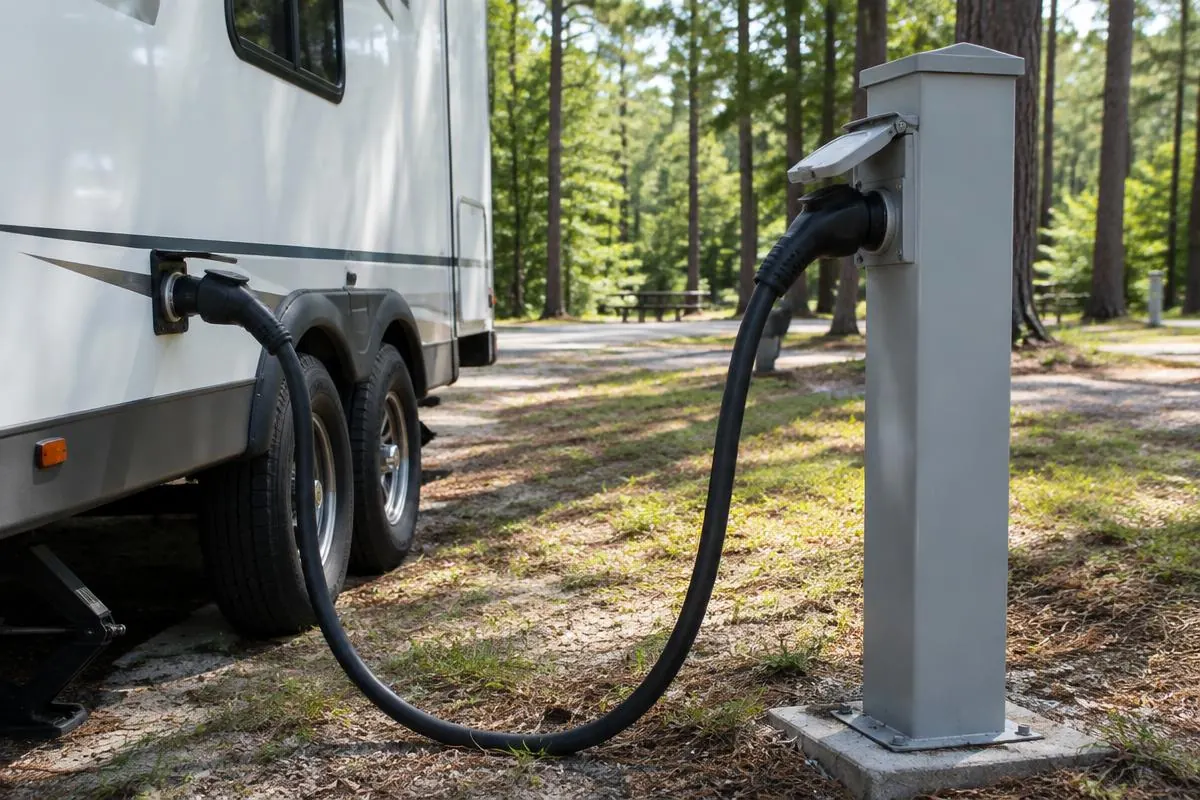
If your RV keeps losing power at a campground, first identify whether all power disappears or only certain outlets and appliances stop working. That tells you where to look next. Check the campground pedestal breaker from the outside, your RV's accessible breaker panel and GFCI reset buttons. A loss of 120-volt shore power is different from a loss of 12-volt lights and controls; both can appear to happen at once when the battery is already low.
Notice what actually loses power
Turn off major loads before resetting a breaker. If it immediately trips again, stop and arrange help. A breaker is warning you that something may be overloaded or faulty. It should not be held on, replaced with a larger one or repeatedly reset to finish the weekend. Let the campground staff know if the problem appears to start at the pedestal, especially if neighboring sites are affected.
Understand 30-amp and 50-amp hookups
A 30-amp RV hookup and a 50-amp RV hookup use different connectors and supply arrangements. A correctly rated adapter can allow a compatible connection, but it does not give a 30-amp RV the capacity of a 50-amp service. Running the A/C, water heater, microwave and other heavy loads at once can trip a 30-amp breaker. Try switching off large loads and testing one system at a time to see whether the interruption tracks total demand.
Never force a plug into an incompatible outlet or use household extension cords as a substitute for an RV shore cord. Look for burns, melted plastic, looseness, arcing marks or an unusual hot smell at the accessible plug. If you see any of these, disconnect power if safe and do not reconnect until the cord and supply are inspected. A loose connection can damage both the RV inlet and the pedestal.
Find a tripped GFCI
If lights and the A/C work but an outlet near the kitchen or bath is dead, a GFCI may have tripped. One GFCI can protect several downstream receptacles, so the reset button may not be at the dead outlet. Unplug devices from the affected circuit, follow the RV manual to locate the accessible GFCI and try a single reset. If it will not stay set, leave that circuit off and have the source of the fault found.
Moisture after humid weather or rain is one possible trigger, but a tripped GFCI does not prove a specific leak. Do not remove covers, test energized wires or defeat the protection. Note which receptacles are affected and whether the problem occurs only when a particular appliance is plugged in. That detail can save time during an on-site inspection.
Remember the 12-volt side
The converter typically helps supply 12-volt loads and charge the house battery when shore power is connected. If lights dim, the furnace fails or the battery monitor falls while the pedestal still supplies 120-volt power, ask for a converter and battery-system check. A failing connection, battery or converter can make a campground power problem seem intermittent even when the pedestal itself is stable.
At a park near Village Creek or along I-10, write down your pedestal rating, RV hookup type, which breaker or GFCI tripped and what appliances were running. Anytime Mobile RV Service can troubleshoot accessible shore-power and RV-side electrical components where your unit is parked. Electrical faults deserve careful diagnosis, not trial-and-error repairs around a live hookup.
Keep the problem isolated and documented
Use a simple list of affected circuits. Record whether the microwave, air conditioner, outlets and 12-volt lights still operate after a loss. If only one appliance stops, check that appliance's own controls and follow its manual before assuming the whole RV has lost shore power. If the entire RV goes dark, check the battery status and pedestal only from accessible, safe positions. Do not remove energized covers to chase a fault.
Rain can add another clue. An outdoor receptacle or damaged shore cord that becomes problematic when wet should be left unused until inspected. Keep connections off standing water and do not try to dry a damaged plug and reconnect it immediately. A surge protector or electrical management device may display a fault code; photograph the display and consult its manual. Its warning should not be overridden just to restore service.
If a campground staff member moves you to another site and the problem disappears, tell the technician anyway if the previous plug had heat damage. A damaged connection can remain dangerous even when a new pedestal seems to work. On the other hand, if the same symptoms follow the RV to multiple sites, a careful RV-side inspection becomes more important. Keeping those observations separate prevents unnecessary work on the wrong side of the hookup.
Related help
Anytime Mobile RV Service comes to your RV seven days a week, 5 AM to 7 PM. Call +1 855-350-4192 to discuss your repair.